

My apologies Ladies.
I was stranded in this storm (yesterday and today).
The photo shows our old iron bridge
on the Medway River.
My son drove me home and by that time it
was so late I was not able to post the
last of the onion dye tutorial.
So here it is...

It is really a very fun and easy dyeing method
but it does have limitations....
more about those later.
Add the 'mother' onion dye and water
to your 'only for dyeing' pot.
The amounts of 'mother' and water depends
on how dark you want the wool.

The above photo shows how the strength of the 'mother'
and water will change light shades of wool.
More about this later in the post...

Heat the water to steam coming from the pot.
Do not boil the dye mixture.
Add the pennies or wool.
It is not necessary to wet the pennies/wool
when adding to the dye water.
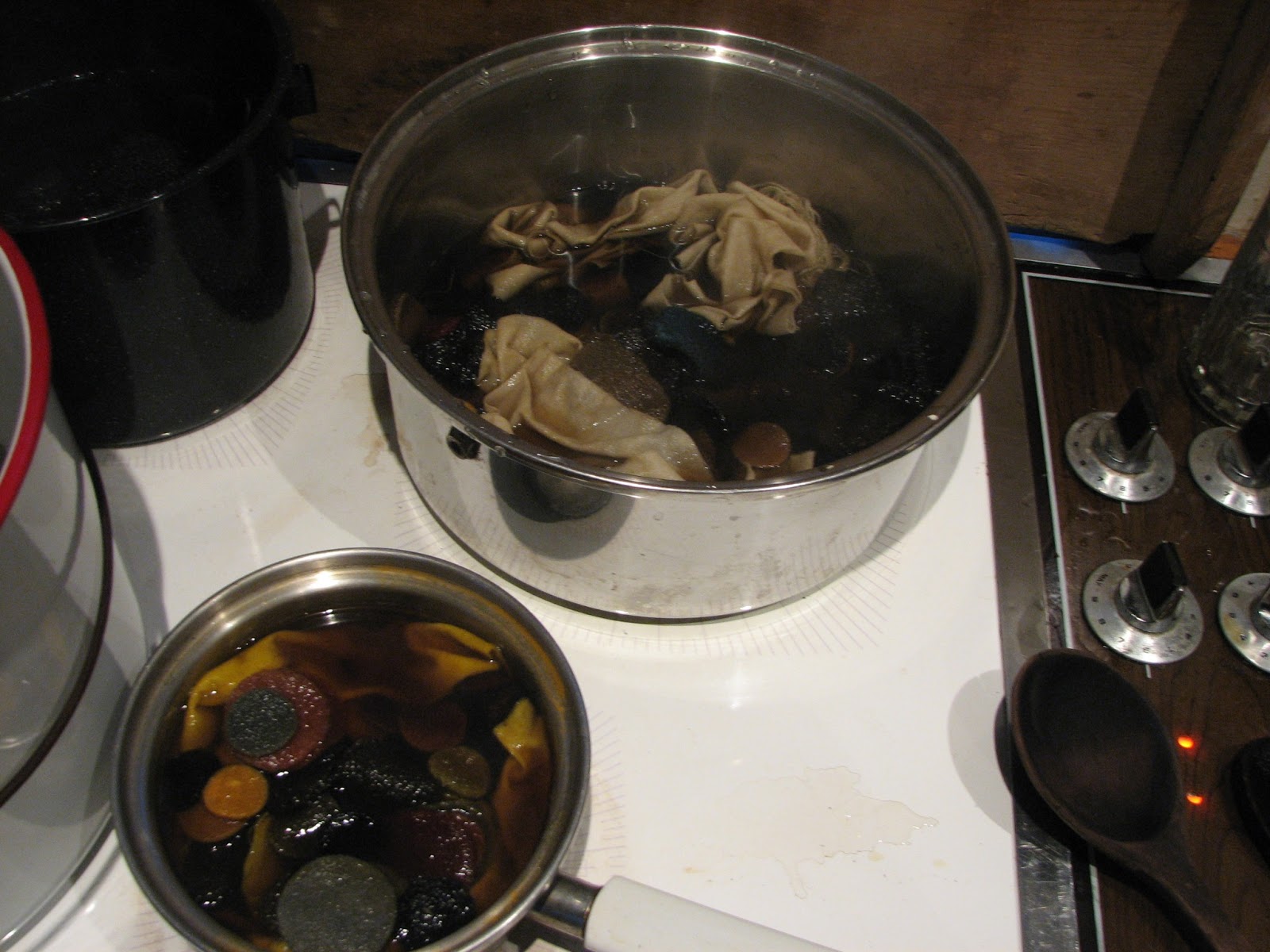
It is not necessary to have everything
completely under the dye water.
Keep stiring and moving around in the pot
to make sure everything is evenly
saturated in the dye.
Let steam
(make sure you do not see bubbles in the pot)
for 15 or 20 minutes to
half an hour.
Nothing is exact in onion dyeing.

Move the pennies/wool to one side
of the pot then add a 'glug' or two or three
of white vinegar and a
teaspoon or tablespoon of coarse salt.
What is a 'glug'?
It's the sound when the vingear comes
out of the jug... glug... glug... glug...
No exact measurements on vinegar or salt
I will go into this later in the posting.

How do you know if you have added
enough vinegar and salt?
This is where the second most important
dyeing tool is used.
The photo above shows the colour
of the dye bath before adding wool.
Vinegar and salt both
hold the dye in the wool/cloth.
They keep it from fading and also
change the shading of the dye.
Vinegar tends to brighten colours.
Salt tends to sadden or drab colours.
I use both in all of my dyeing,
even with my acid dyes.
even with my acid dyes.
After adding vinegar and salt let
the mixture simmer(pot is steaming)
for 5 or 10 minutes depending
on the strength you have used
of the 'mother' dye.
How do you know you have used
enough vinegar and the dye bath
has simmered enough?
Pour the dye water from the pot
into your clear glass cup.
The water should be either clear
or very light in colour.

The above photo shows the dye water
after the vinegar and salt were added.
My experience with onion dye is
that it will not completely clear.
If the water is still dark this
means you try more vinegar.
Simmer for 5 minutes or more... then
check the water in the glass again.
check the water in the glass again.
Turn off the heat and let
the pennies/wool sit in
the dye bath over night.
This is very important with
natural dyeing.
Next morning remove pennies/wool
from the pot to a sink of hot water.
Add a bit of detergent if desired.
Rinse, dry and enjoy!

I have shown pastel wool pennies dyed
in the onion bath but the process
is exactly the same for pieces of
wool, cottons, threads and
wool blend fabrics.
Last post on the onion dye tutorial
will explain how to know
the strength of your dye plus
more tips and techniques for
dyeing wool used to create
penny rugs.
I hope to have it posted tomorrow
but weekends are very busy
for me so please
check back often as
my 'subscribe' by email from
mail chimp doesn't seem to
be working yet again!
I could really start hating blogger!
Until next time...
Stay safe and warm...
cee


.JPG)


